


National Geographic 1998 February
Publisher: National Geographic
Format: Paperback
ISBN: none
Step right up for a time capsule from the late-1990s, when the world was convinced the millennium was about to arrive in a chrome hovercar and National Geographic responded in the only sensible way: a Millennium Supplement about “Exploration”. Because nothing says “the future” like a 110-year-old magazine calmly reminding you that humans will always look at a blank bit of map and think, I should probably suffer there.
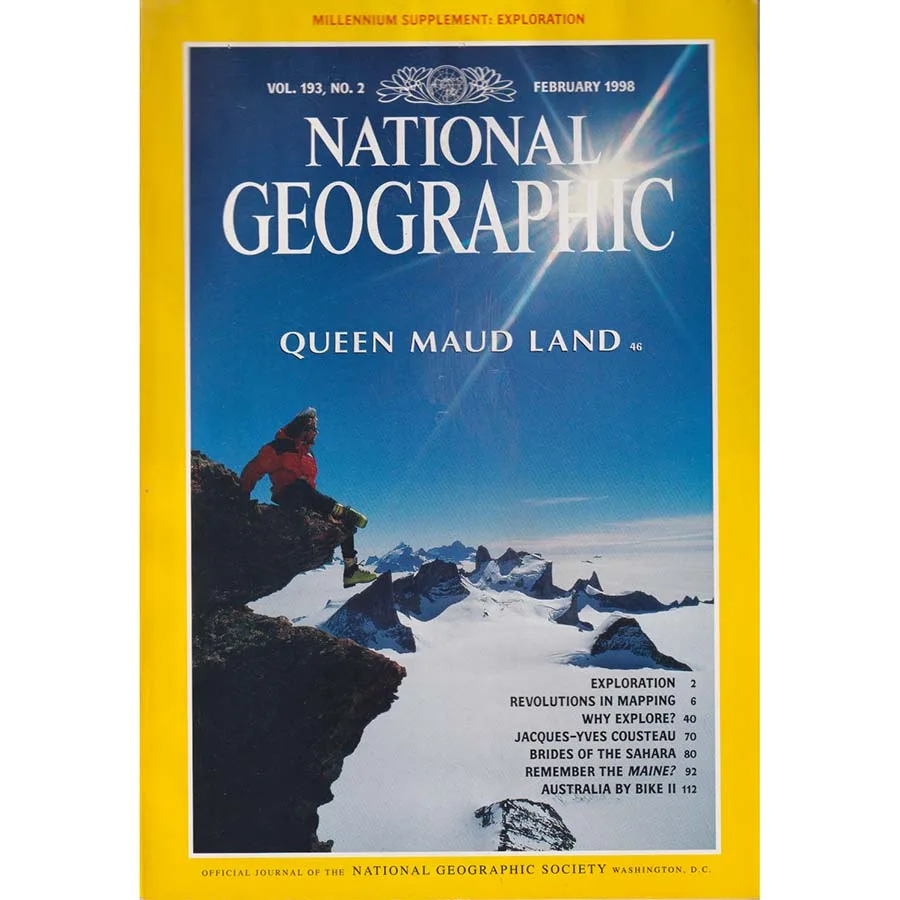
This is National Geographic, February 1998 (Vol. 193, No. 2), wearing its famous yellow frame like a ceremonial sash and serving a cover that’s basically a motivational poster with hypothermia: a lone figure perched on dark rock, staring over the icy drama of Queen Maud Land. It’s the kind of view that makes you want to whisper “majestic” while also wondering how quickly your eyelashes would freeze together if you tried it.
Inside, it’s a full buffet of adventurous optimism and earnest curiosity. You get big-idea stuff like “Why Explore?” (a philosophical deep breath that boils down to: because it’s there, because we can, because we apparently love logistical misery). You get revolutions in mapping, which is delightfully on-brand for a magazine that has been quietly turning walls into geography shrines for generations. You get Jacques-Yves Cousteau, patron saint of calm underwater narration and the belief that humans can save the planet if we just learn to look cooler while doing it.
Then, because National Geographic never travels in a straight line, you’re whisked from polar extremes to human stories and historical rabbit holes: “Brides of the Sahara” (romance and resilience under a sky that does not negotiate), “Remember the Maine?” (history with a slow-burn sense of “wait, this is more complicated than I was told”), and Australia by bike II, which is basically a polite way of saying, “Yes, we chose the hardest possible commute and we’d like you to admire it.”
Condition: Good — which, in Crappy Old Books language, means it’s ready to be read, admired, and used for the noble purpose it was born for: making you feel simultaneously inspired and extremely comfortable staying indoors. Expect that classic National Geographic vibe: gorgeous ambition, measured wonder, and the quiet confidence of a publication that knows you will, at some point, become emotionally attached to an article about mapping or sand.
If you want a single issue that captures the 1998 belief that the next century would be solved by curiosity, courage, and better cartography—this is it. A glossy invitation to explore… from the safest chair in your house.
Keep browsing: See more National Geographic books Other books by National Geographic
